Human-in-the-Loop AI: Why Your Agent Still Needs a Human in Charge
AI agents can plan, reason, and act across dozens of steps without you lifting a finger. That is exactly why knowing when to put a human back in the picture is one of the most important design decisions you can make.
What Is Human-in-the-Loop Design?
Human-in-the-loop (HITL) design is an approach to building AI systems where humans are intentionally placed at specific decision points within an automated workflow. Rather than letting an AI run from start to finish unattended, the system pauses at defined moments, surfaces what it has done and what it is about to do, and waits for a human to review, approve, correct, or redirect it before continuing.
The concept originates in control systems engineering, where certain processes required human judgement before a machine could proceed. In early machine learning pipelines, it described humans labelling training data or validating model outputs before they fed back into a system. In the world of agentic AI, the meaning sharpens considerably, because the stakes are different. Agents do not just produce outputs for humans to review. They take real actions: sending emails, writing to databases, calling APIs, triggering downstream workflows.
HITL sits between two extremes. Human-on-the-loop means the system runs continuously and a human can intervene but is not required to. Human-out-of-the-loop is full automation with no checkpoints at all. Good HITL design chooses deliberately where each part of a workflow sits on this spectrum, based on the consequences of errors rather than on convenience.
In practice, HITL means asking: which decisions are consequential enough that a human should own them, and at what point in the workflow should that ownership happen? The answer shapes everything about how a system is built and how much it can actually be trusted.
How Does Human-in-the-Loop Actually Work?
HITL is not a single feature you switch on. It is a design pattern that takes several different forms depending on the nature of the task, how frequently human input is realistic, and how much reliability the agent has already demonstrated. Here are the main patterns used in production agentic systems today.
The Checkpoint Pattern
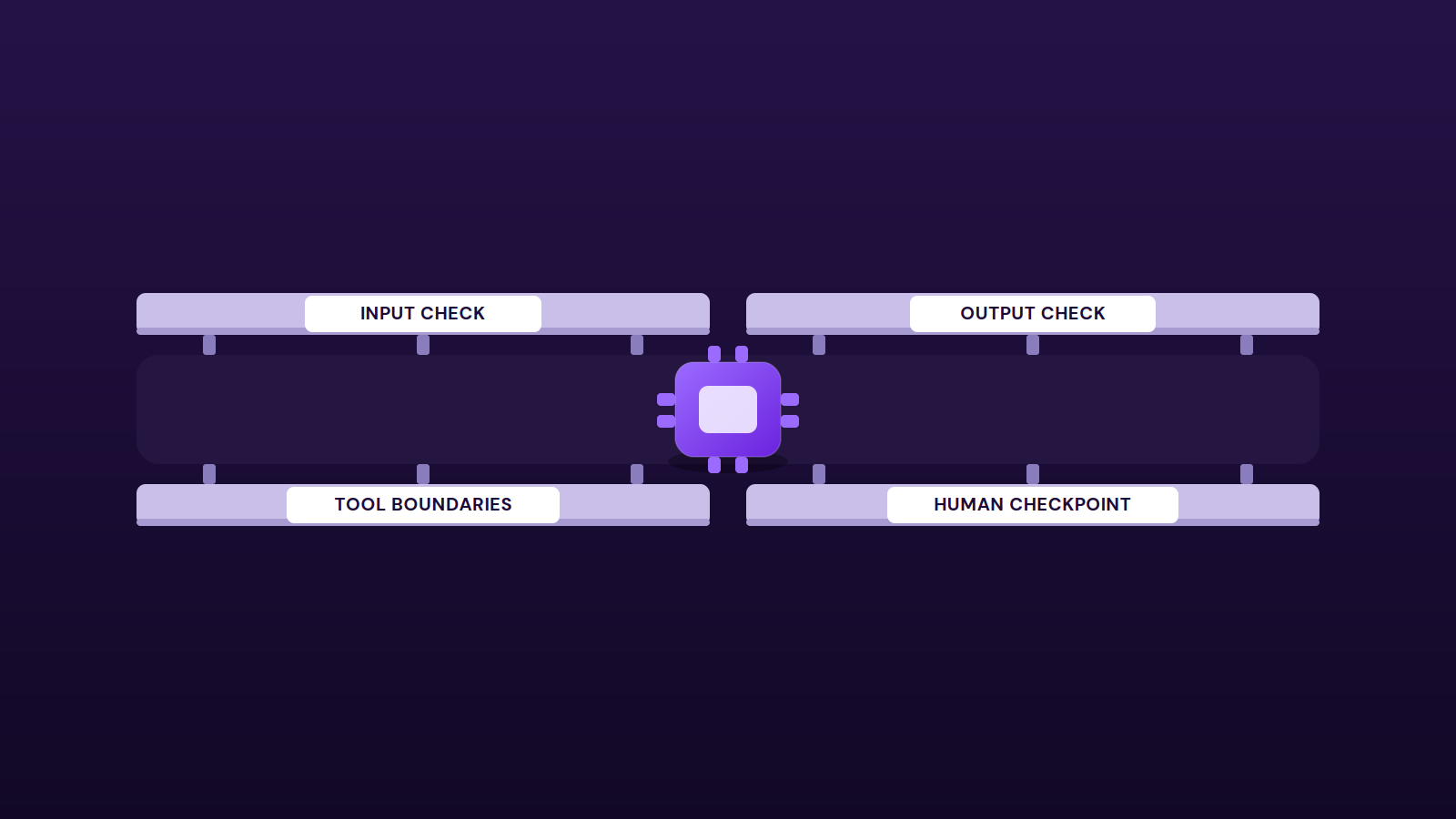
The most common form of HITL. Execution pauses at a predefined moment, the agent presents a summary of what it has done and what it plans to do next, and the human approves, modifies, or rejects before the agent continues. Checkpoints typically appear before irreversible actions, before external communications like sending emails, and at natural phase boundaries in complex, multi-step tasks.
The Draft-and-Review Pattern
The agent produces a complete draft of its intended output or plan, and presents it for human review before taking any real-world action. This is natural for knowledge work: the agent writes the email, the human approves and sends it. The agent builds a content calendar, the human signs off, then the agent schedules the posts. The human sees the full picture before anything goes live.
The Confidence-Gated Pattern
The agent handles actions autonomously when they meet a defined risk threshold, and escalates to a human for anything below it. Importantly, this should not rely solely on a model's self-reported confidence. Large language models are frequently miscalibrated and can express high certainty about incorrect conclusions. Robust confidence-gating uses external logic: rule-based criteria, defined risk categories, or a separate evaluation layer designed specifically to flag edge cases.
The Interrupt Pattern
The agent runs continuously, but a monitoring interface lets a human pause, inspect, redirect, or stop it at any time. This suits longer-running tasks where defining discrete checkpoints in advance is difficult. The main risk is disengagement: humans often stop monitoring passively, which means errors can compound before being caught. This pattern works best when paired with automated alerting on specific trigger conditions rather than relying on passive observation.
Every checkpoint should communicate three things: what the agent did, what it is about to do next, and what the human's options are. A checkpoint that just asks "Proceed? Yes/No" without context is not meaningful oversight. It is a false sense of control dressed up as a button.
Why Do We Actually Need Human-in-the-Loop?
When a standard AI model produces a wrong answer, a human reads it, discards it, and moves on. The model took no action. In agentic systems, the AI is the actuator. When it makes a wrong decision at step three of a ten-step workflow, it may have already sent an email, modified a database record, or triggered a process that is now running independently. By the time the error surfaces, reversal is expensive or impossible.
Several properties of agentic systems make this risk especially serious:
Error Compounding
A wrong assumption at step two flows into steps three through ten. Each action reinforces a flawed premise, and by the time the error is noticed, it may have cascaded across dozens of decisions.
Irreversible Actions
Sending an email, posting publicly, deleting records, or submitting a form cannot always be undone. HITL gates these before they happen, not after the damage is done.
Ambiguous Instructions
Users often give agents underspecified goals. Without a clarification step before acting, an agent charges ahead on its best interpretation, which may differ significantly from what was actually intended.
Prompt Injection
Agents that read external content are exposed to adversarial instructions hidden in web pages, emails, or documents. A HITL checkpoint lets a human catch hijacked behaviour before it becomes a real-world action.
Capability Outpacing Trust
Model capability is advancing faster than our ability to verify model judgement. HITL bridges that gap deliberately, letting agents operate while humans validate that trust is actually warranted.
Accountability
Organisations are responsible for what their automated systems do. HITL creates a clear record of which decisions were explicitly authorized by a human, and which were made autonomously.
HITL is also how you build a case for giving agents more autonomy over time. Agents that are never overseen are never validated. Agents that have been supervised, corrected, and proven reliable in specific domains are agents that can eventually be trusted to operate with less friction in those areas. Oversight is not the enemy of capability. It is the path to it.
The Drawbacks: What HITL Does Not Solve
HITL is not a free lunch. Building it well means grappling honestly with its costs and failure modes. Treating it as a simple safety checkbox, without addressing these tradeoffs, creates systems that have the appearance of oversight without the substance of it.
The goal is not maximum HITL. It is right-sized HITL: frequent enough to catch consequential mistakes before they happen, infrequent enough that reviewers are genuinely engaged when they appear. Calibrating this is a product design problem as much as an engineering one.
Where HITL Already Shows Up
Across industries, the pattern is consistent: AI handles speed and scale, humans handle judgement and accountability. Here is what that looks like in practice.
AI-Assisted Medical Imaging
AI tools used in radiology, such as those detecting tumors or fractures in scans, are typically cleared under regulatory frameworks that require clinician sign-off. The AI flags and highlights areas of concern; a radiologist reviews and takes responsibility for the diagnosis before anything reaches the patient.
Pattern: Checkpoint before diagnosis is communicated
Contract Review Agents
AI legal tools can review contracts, flag unusual clauses, and surface risk areas quickly. But no contract gets signed or sent based on the AI's output alone. A lawyer reviews the flagged sections, makes the judgement calls, and approves the final document before it leaves the firm.
Pattern: Draft-and-review before any external action
AI-to-Human Escalation
Support AI handles routine queries autonomously: order status, account changes, common troubleshooting. When it detects frustration, complexity, or a scenario outside its training, it flags the conversation and routes it to a human agent with full context of what has already been handled.
Pattern: Confidence-gated escalation
Fraud Detection Review
Banks use AI to flag transactions that match fraud patterns in real time. The AI does not block automatically. A compliance analyst reviews the signal and makes the call to block, allow, or escalate. Speed matters, but a wrongly blocked transaction has its own significant cost.
Pattern: Confidence-gated with human final decision
Content Moderation
Platforms use AI to classify and flag potentially policy-violating content at scale. For edge cases and anything context-dependent, human moderators review flagged content and make the final enforcement call. The AI handles volume; humans handle judgement.
Pattern: AI flags, human decides on enforcement
Automated Candidate Screening
AI screening tools can rank and surface candidates based on defined criteria, but hiring decisions stay with the hiring manager. Shortlists are reviewed and often adjusted based on context the AI did not have. The final call on who advances stays human.
Pattern: AI shortlists, human decides who advances
What these examples share is a clear division of labour: the AI handles speed, scale, and pattern recognition. The human handles judgement, context, and accountability. Neither works as well without the other in high-stakes environments.
How Trust Gets Built Through HITL
One of the most underappreciated things HITL does is create the conditions for expanding AI autonomy responsibly over time. The right relationship between humans and agents is not static. It should evolve as the agent demonstrates reliability in specific domains, under specific conditions, at specific levels of task complexity.
Every checkpoint generates a data point: did the human agree with the agent's proposed action? Did they modify it? Did they reject it entirely? Over time, this record tells you where the agent's judgement holds up and where it still needs correction. That is the foundation on which you can start adjusting oversight levels, grounded in evidence rather than optimism.
Every meaningful action passes a checkpoint. Logs reviewed closely. Reliability baseline being established.
Proven tasks run autonomously. High-risk or novel decisions still escalate. Trust is domain-specific.
Agent runs freely in validated domains. Logs audited on a schedule. Autonomy revocable at any time.
This mirrors how organisations already manage human teams. A new hire's work gets reviewed before it ships. A proven senior delivers directly. The trust was not assumed upfront; it accumulated through a track record of good decisions. HITL builds that same mechanism into AI systems.
The key insight is that HITL is not a sign that an AI system is not yet capable enough. It is the mechanism by which you find out whether it is capable enough, in which specific domains, under which conditions. That finding is valuable. It tells you where to invest in improving the agent, where to confidently expand its scope, and where to keep humans firmly in the picture.
Humans Have a Responsibility Here Too
HITL design places obligations on both sides. A lot of attention goes to designing agents that know when to pause. But the human side of the loop carries its own serious responsibility, and it is one that is easy to underestimate once automation starts feeling routine.
When a human approves an agent's proposed action at a checkpoint, they are not just clicking a button. They are authorizing a real-world consequence. That authorization comes with accountability. If the agent sends a damaging email, deletes the wrong records, or makes a flawed business decision after receiving human approval, the human who approved it shares responsibility for the outcome.
Being a good human-in-the-loop requires active engagement, not passive rubber-stamping. Specifically:
- 1
Understand what you are reviewing.
A reviewer who does not understand the domain well enough to evaluate the agent's proposed action should not be the one approving it. Assigning HITL review to the wrong person is as dangerous as having no review at all.
- 2
Actually read the checkpoint.
Alert fatigue is a documented risk. Humans must resist the pull to approve by default. If a checkpoint feels trivial, the right question is whether the system's granularity needs adjusting, not whether this particular review can be skipped.
- 3
Flag when the agent's reasoning looks off.
Checkpoints are not just approval gates. They are opportunities to spot patterns of misunderstanding. If an agent is consistently proposing actions that need correction in one area, that is a signal to investigate the underlying instructions, not just to keep correcting manually and moving on.
- 4
Do not override safety guardrails for convenience.
Some HITL systems allow humans to bypass safety checks in the name of speed. This is precisely where serious failures originate. Guardrails exist because someone decided, in advance and with careful thought, that certain actions should require additional review. That judgement deserves respect.
- 5
Keep the audit trail accurate.
Logging the agent's actions is only useful if what actually happened is recorded honestly. Humans who approve without reviewing, or document approvals that were not genuine, corrupt the data that makes the entire HITL system meaningful over time.
HITL design distributes responsibility between the AI and the humans overseeing it. The goal is not to transfer all responsibility to the AI while humans passively watch, nor to use the AI as a scapegoat when things go wrong. It is a genuine partnership where both sides are accountable for the outcomes they authorize.
The organisations that get the most from agentic AI are not the ones that minimise human involvement as fast as possible. They are the ones that invest in reviewers who genuinely understand what their agents are doing, and who treat that responsibility seriously. The agent is powerful. The human is still in charge.
Want this in your business?
If keeping a human in control of high-stakes decisions inside an otherwise autonomous AI workflow is something you're facing, it's exactly what we build in our Inside your stack work.
Frequently asked questions
What is human-in-the-loop AI?
Human-in-the-loop (HITL) AI is a design pattern where a person reviews or approves specific decisions inside an otherwise autonomous AI workflow. The AI does the reading, reasoning, and drafting; the human confirms before anything consequential happens.
When should you use a human-in-the-loop pattern?
Use HITL when the cost of a wrong action is meaningfully higher than the cost of a small delay — customer communications, financial transactions, legal or compliance work, and any irreversible external action. For low-stakes, high-volume work, full autonomy is usually fine.
Does human-in-the-loop slow AI down?
Only where you place a gate. Well-designed HITL systems batch approvals, use confidence thresholds to auto-approve routine cases, and route only genuine edge cases to humans. In practice, HITL usually speeds work up by keeping the AI running until a decision that actually needs a person.
How does Codefully do this?
We deliver this as Inside your stack. AI embedded into the tools your team already uses — no rip-and-replace.