The four levels of AI for business
AI for business ranges from a tool you prompt to a system that runs your operations — and knowing the difference is where strategy begins.
Most businesses using AI are operating at one of four distinct levels. Each level is fundamentally different in what it does, what it requires to implement, and what it actually changes about how the business operates.
Understanding where you sit on that spectrum is one of the more practically useful things you can do before committing to an AI investment. This article maps each level clearly, with real examples of what each one looks like in practice.
AI content generation
This is where most businesses start, and there is nothing wrong with that. You have an idea. You put it into an AI tool. You get an output: a draft email, a summary, a document, a social post. Tools like ChatGPT, Claude, Copilot and Gemini live here.
Human initiates every exchange. AI produces. Human approves.
The flow is simple: idea goes in, output comes out. You are still doing the thinking and the deciding. The AI is doing the producing.
Level 1 is genuinely useful. It saves time, reduces friction and raises the floor on a lot of routine work. But it is not automation. It is not a system. It is a capable tool that does what you tell it to, when you tell it to.
What it actually looks like in practice
A marketing manager asks an AI tool to draft five subject line options for a campaign email. A consultant pastes in a 40-page report and asks for a two-paragraph executive summary. A founder describes a product feature and asks for a landing page headline. In each case, a human initiates the exchange, reviews the output, and decides what to do with it.
The human is in the loop for everything: trigger, quality check, and final decision. The AI is waiting for you every time. This is also why Level 1 does not scale in the way businesses hope. If your team is individually prompting AI tools throughout the day, you have made individuals more productive. That is real value. But the business has not changed. The process has not changed. You have better tools doing the same work in the same way.
Where it fits
Level 1 is the right place to start. It builds AI literacy across a team, surfaces where real friction points are, and creates the appetite for going further. Most businesses that eventually reach Level 3 or 4 started by spending genuine time at Level 1, learning what AI is actually good at before trying to build systems around it.
Simple AI automation
This is where a trigger replaces you having to press a button. An email arrives and a spreadsheet updates. A form is submitted and a Slack message goes out. A new contact is added and a follow-up is queued. Tools like n8n, Zapier, Copilot and Claude Cowork operate at this level.
One direction. No branching. No context reading. Runs without you.
The flow is: trigger leads to action leads to result. One direction. No decisions being made along the way. No branching logic. No intelligence reading context.
What it actually looks like in practice
A new lead fills in a contact form on your website. Automatically, their details are added to your CRM, a notification is sent to your sales team on Slack, and a confirmation email goes to the lead. Nobody had to do any of that. It just happened.
Or consider a weekly reporting workflow. Every Friday at 9am, the automation pulls data from your project management tool, compiles it into a standard format and sends it to the relevant stakeholders. Nobody pressed a button. The trigger was the clock.
The limitation worth understanding
Simple automation is rigid by design. It follows a fixed path. If the situation is anything other than what it was built for, it either fails silently or does the wrong thing confidently. There is no sense-making happening. The system does not read the email that arrived and assess whether it needs urgent attention or can wait until Monday. It routes it the same way it routes everything else.
This is not a flaw, exactly. It is simply what Level 2 is. The intelligence is in the person who designed the workflow, not in the system running it. Level 2 works well when your processes are clean and consistent. When they are not, when there are exceptions, edge cases or decisions that depend on context, it starts to break down.
Where it fits
Level 2 is the right layer for operational housekeeping. Data entry, notifications, scheduling, routing, reporting. Anything that happens the same way every time and does not require judgement. The efficiency gains are immediate and the maintenance overhead is low, as long as the workflows stay simple.
Complex AI automation
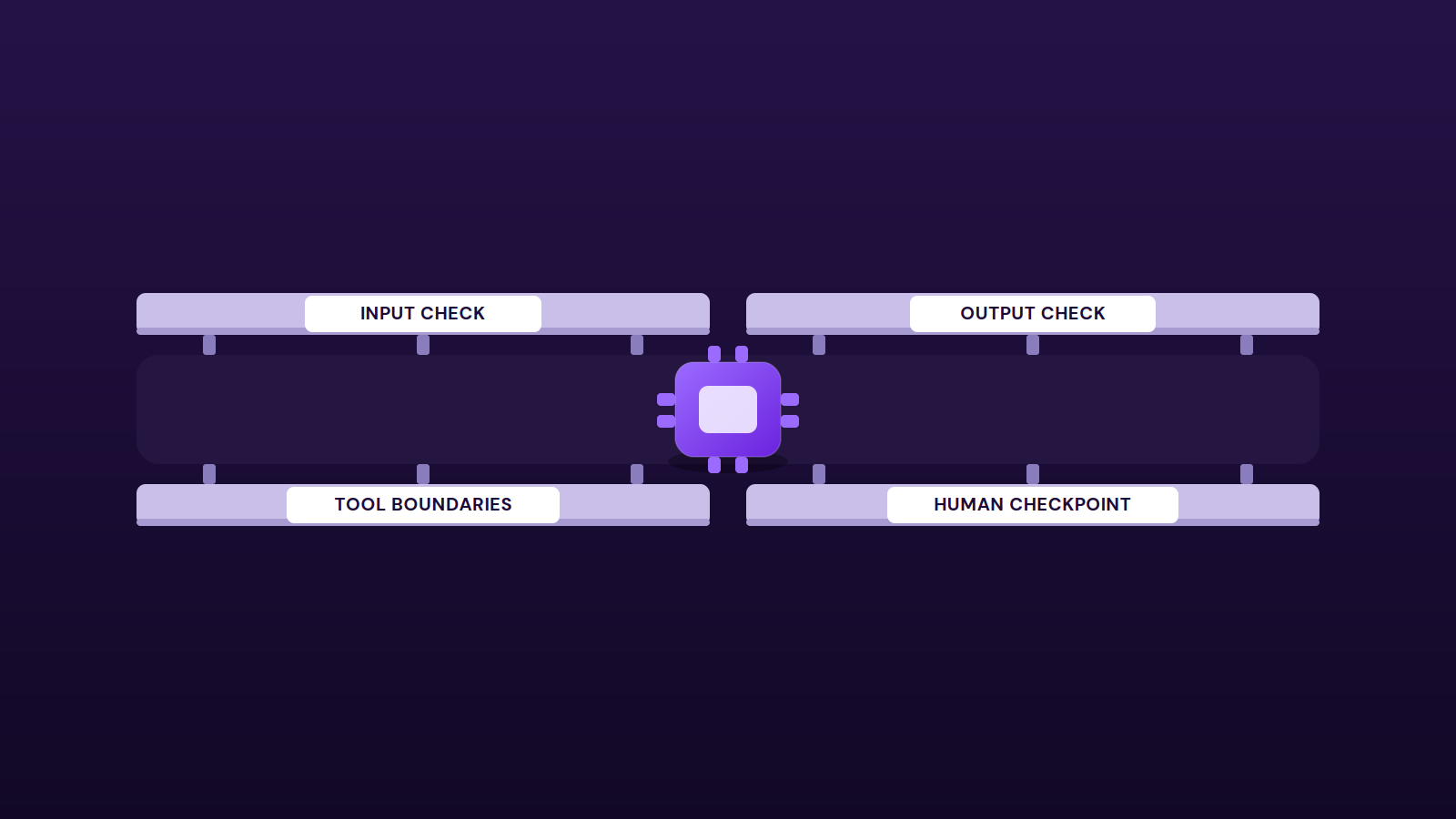
This is where it becomes genuinely interesting. An intelligence layer sits across your existing systems. It reads context. It routes decisions. It waits for human approval before acting. It writes back into the tools your team already uses.
AI reads context, routes decisions, waits for approval, then acts in your existing systems.
Tools operating at this level include Claude Code, Microsoft Foundry, LangChain and Codex. The distinction from Level 2 is that actual reasoning is happening. The AI is not just doing a thing when told to. It is assessing a situation and determining what should happen next.
What it actually looks like in practice
A client emails in with a complaint. Instead of sitting in an inbox until someone picks it up, the system reads the email, identifies it as a complaint, cross-references the client's history and account status, and routes it to the appropriate team member with a summary and a suggested response. If the client is flagged as high-value, it escalates automatically. If it falls below a threshold, it is handled at a lower priority.
Another example: inbound lead qualification. When a new lead arrives, the AI reads the enquiry, checks it against the ideal customer profile, scores it, and if it meets the threshold, drafts a personalised response for a sales rep to review and send. The rep is not writing from scratch. They are approving and refining. Their time goes to the leads worth their time.
The AI does the reading, the reasoning, and the drafting. A human confirms before anything consequential happens. You get the speed of automation without losing oversight over outcomes.
The approval gate
Approval gates are the design feature that makes Level 3 practical for most businesses. The AI does the cognitive work. A human confirms before anything consequential happens. You get the speed and intelligence of automation without losing oversight over outcomes.
Good design note: Starting with approval gates in place is not a weakness. It is how you build trust in a system before giving it more responsibility. As confidence builds, some gates can be removed over time.
Where it fits
Level 3 is the right layer for any process that involves context, judgement or exceptions: customer communications, lead qualification, contract review, internal approvals, issue triage. Anything where the right action depends on understanding the situation rather than just following a rule. It requires meaningful upfront design work, but that investment pays off at scale.
AI system
Level 4 is not a feature. It is a new way of operating. At this level, AI sits at the centre of the business. It is not a tool you reach for. It is the infrastructure through which work flows. Interfaces, an intelligence layer and underlying systems are all connected and working together as a single operating environment.
What it actually looks like in practice
Consider a client services business. At Level 4, the moment a new enquiry arrives through any channel, whether email, a web form, WhatsApp or a portal, the system reads it, qualifies it, logs it in the CRM, assigns it to the right team member, drafts an initial response and creates an onboarding task list. A dashboard gives the team live visibility of everything in motion: active clients, pending tasks, at-risk accounts, pipeline status.
The AI layer has memory. It knows the history of every client relationship. It reasons across that history to surface what matters: this client has not engaged in three weeks, this project is running behind on milestones, this account is showing signs of churn. It flags these things before a human would have noticed.
Over time, it learns in a specific operational sense. It gets better at predicting what a client will need, what a project will require, and what the team's capacity actually looks like at any given point.
What changes at Level 4
At Levels 1 through 3, you are improving existing processes. You are doing the same work faster, with less manual effort, or with more intelligence applied at each step. At Level 4, you are questioning whether those processes should exist in the form they currently do at all.
Tasks that previously required a person to notice, decide and act are handled by the system. New enquiries replied to. Leads qualified. Weekly reports generated. At-risk clients flagged before anyone had to look. Tasks created and assigned without anyone opening a project management tool. The people in the business shift from doing operational work to doing strategic work.
This is a significant organisational change. It requires investment, not just in technology but in how the business is structured and how people work within it. Tools like Microsoft Foundry, LangGraph, Claude Code and custom builds make it technically achievable. The organisational readiness to implement and sustain it is the harder part.
Where it fits
The businesses that get the most from Level 4 are the ones that have done the work at Levels 2 and 3 first. They understand their processes in detail. They have built confidence in AI-assisted decisions. They have the data infrastructure to support it. And they have leadership that understands what they are building toward, not just the outcome they want to announce.
Where are you on the spectrum?
Most businesses are operating at Level 1 or early Level 2. That is not a criticism. It takes time to understand what AI can actually do before restructuring around it.
But it is worth being clear-eyed about where you are, because the conversation changes depending on the answer. Level 1 gives you better outputs. Level 2 saves you manual steps. Level 3 gives you systems that think. Level 4 changes the shape of the business itself.
The progression is not just about technology. Each level requires a deeper understanding of your own processes, a higher tolerance for redesigning how work happens, and a clearer picture of what you want the business to look like. Most organisations that are serious about AI do not jump straight to Level 4. They start at Level 1 to build understanding, move to Level 2 to remove operational friction, invest in Level 3 when they are ready to apply intelligence to their most important processes, and approach Level 4 when they are ready to stop optimising the old model and start building a new one.
The question is not whether to use AI. It is how far you want to take it, and whether your current setup is actually matched to your ambitions.
Want this in your business?
If figuring out where AI fits in your business and how to move from experiments to operational systems is something you're facing, it's exactly what we build in our Fractional Chief AI Leadership work.
Frequently asked questions
What are the four levels of AI for business?
The four levels are: (1) AI content generation, where a human prompts a tool like ChatGPT for an output; (2) simple AI automation, where a trigger runs a fixed workflow; (3) complex AI automation, where an intelligence layer reads context and routes decisions with human approval; and (4) full AI systems, where AI is the infrastructure through which work flows across the business.
What is the difference between AI automation and an AI system?
AI automation runs a workflow when triggered — it does one thing well but cannot handle exceptions. An AI system sits across your tools, holds memory of context, reasons about what should happen, and coordinates work end-to-end. Automation makes tasks faster; a system changes how the business operates.
Where should a business start with AI?
Most businesses should start at Level 1 with tools like ChatGPT or Claude to build AI literacy and surface real friction points. Once your team understands what AI is good at, Level 3 — complex automation with approval gates — usually delivers the highest ROI because it targets work that requires judgement.
What is an AI approval gate?
An approval gate is a design feature in Level 3 AI systems where the AI does the reading, reasoning, and drafting, but a human confirms before anything consequential happens. It gives you the speed of automation without losing oversight over outcomes, and gates can be removed over time as trust builds.
How does Codefully do this?
We deliver this as Fractional Chief AI Leadership. Senior AI leadership on retainer — roadmap, AI Audit, and org analysis without a full-time hire.